
Home » Posts tagged 'farm'
Tag Archives: farm
Sowing seeds of support: Grow Food Northampton meets $1M goal to help local farms, fight hunger
| Original Post – Daily Hampshire Gazette | Published: 08-05-2025 3:41 PM Modified: 08-05-2025 5:41 PM |
By GRACE CHAI
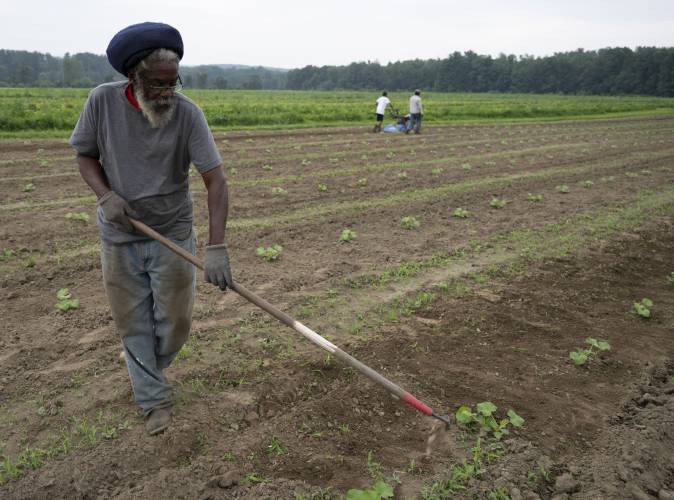
NORTHAMPTON — Leaning out of the window of his blue truck on a hot summer day last week, Courtney Whitely of Ras Farm recounted his journey to farming.
The Jamaica native had been a farmer for a long time working for other farms in the area before he obtained land to grow his own produce from Grow Food Northampton. To him, growing food requires a connection to the land, and understanding how to grow food that nourishes the body is important.
“You have to be one with the land,” Whitely said.
He learns a lot from the land, including when growing certain food doesn’t work out one season. Last year, he tried to plant kallaloo, a leafy green used in many Jamaican dishes, using plastic materials to support its growth, but it didn’t grow well. After planting it again differently this year, it thrived.
Now Whitely grows butternut squash, jalapenos and other vegetables to sell at Grow Food’s Tuesday Farmers Market. He found out about the Northampton nonprofit while browsing a website called New England Farmland Finder, where he discovered that the organization leases land to small farms.
Whitely is one of 10 farmers who have been able to lease land at affordable prices from Grow Food, the largest community farm in Massachusetts whose mission is to support local farms, provide land- and food-based education for children and adults, advocate for food security and practice sustainability.
The nonprofit’s role in the community began in 2010, when founders Lilly Lombard and Adele Franks — with the support of over 800 petition signatures from locals — lobbied for 121 acres in Florence to be preserved as farmland.
In the 15 years since its founding, Grow Food has established a community farm where it leases land to small farms, oversees a 320-plot community garden where people can grow their own food for an annual fee of $40 (or pay on a sliding scale), and operates a Giving Garden that grows thousands of pounds of food annually for donation to local food pantries and community meal sites. Grow Food also promotes education on local food and farming, runs a Tuesday Farmers Market and delivers free food to nine low-income housing sites each week.
This work has been bolstered along the way by a combination of funding sources, including the Northampton community and federal and state grants.
But as federal grants began to get wiped out under the Trump administration, Grow Food’s leaders saw the “writing on the wall,” as co-Executive Director Alisa Klein puts it, and last fall launched a campaign to raise more than $1 million for its Community Roots Fund. The campaign collected some $900,000 in private donations over the course of several months before opening to the public in June. Within six weeks, the organization raised the remaining $100,000.
Klein said that community members contributed with “remarkable generosity,” crediting the huge community response to people recognizing the role that Grow Food plays in feeding people in the city.
Klein says that while the organization had an “infusion of funds” for capital projects, its $1 million campaign is critical operational funding that will allow it to continue their programs and initiatives. The money will be used to support local farms and gardeners in the Community Garden and to implement climate resilience measures.
Some of these programs support its mission of education, as the organization has established a close relationship with Northampton Public Schools where students come to the community garden on an annual field trip.
“If we can engage kids in the local food system at a young age, if we can impart to them a sense of agency that they can create a healthy, vibrant, resilient local food system … they will go on to be kind of citizen activists to create that healthy local food system,” said Klein. “We feel like it’s really important to give them the tools to learn how to grow food, to have a relationship with the land.”
Grow Food also has classes on the community farm for adults to learn about farming and gardening. Klein says that the organization hones in on the cultural origins of different kinds of food and they talk about the history of the land.
Some of these programs will take place in a new pole barn, funded by a federal grant from U.S. Rep. Jim McGovern and a city grant from the Community Preservation Act, that Grow Food will use to host events, educational classes and more.
Recently, Grow Food held an event at its Living History garden, where food from different cultures grows alongside each other. Walking through the Living History garden feels like flipping through a richly diverse family album: covered in green leaves on a trellis are bumpy green bitter gourds; illuminated in bright sunlight are red okra, flax and molokhia, a leafy green used in many traditional Middle Eastern dishes. The garden represents the larger story of people hailing from all over the world who came to Northampton.
Impact of federal cuts
The organization relies on local generosity and private funding more than before to support these kinds of programs. According to Klein, Grow Food lost nearly one third of its budget due to federal funding cuts for grants such as the Local Food Purchase Assistance Cooperative Agreement Program (LFPA), which provided funding for groups like GFN that buy food from socially disadvantaged farmers and producers to provide to underserved communities.
Previously, the LFPA grant it received provided $400,000 over the course of three years. The nonprofit expected to renew the U.S. Department of Agriculture grant for another three years, but it was terminated in March.
Grow Food has also lost funding from a Farm to School grant that would have provided $50,000 for GFN’s education programs.
“We saw the writing on the wall, that we knew that hunger and food insecurity [were] rising in this valley,” said Klein. “And so we knew that we were at a moment where we had to figure out how to strengthen the organization’s ability to continue our work and to continue to feed people in the community.”
According to the Greater Boston Food Bank’s fifth statewide Food Access Report, food insecurity among Massachusetts households has increased to 37% in 2024 based on survey data. In the same report, Hampshire and Franklin counties were shown to be 50% food insecure and Hampden County as 54% food insecure, with food insecurity defined as “the experience of being unable to afford enough food to eat or worrying about where one’s next meal will come from.”
Role of farmers market
One way Grow Food combats food insecurity is through its Tuesday Farmers Market, which takes place behind Thornes Marketplace from April until November.
A popular community fixture, the market bustles with activity on a typical afternoon, with about 30 vendors selling produce and other goods to customers. Grow Food does Supplemental Nutrition Assistance Program (SNAP) matching at the market, doubling up to $10 of customers’ SNAP money. For every $10 spent in SNAP, for example, GFN gives someone $20 in tokens to buy anything SNAP eligible, like meat, cheese, fruits and vegetables. Massachusetts’ Healthy Incentives Program (HIP) is another program that helps SNAP recipients access free, local produce up to $40 per month and is also available at the farmers market.
Farmers market Manager Helen Kahn organizes the music, vendors and SNAP transactions. Standing under a tent that provided some respite from the blazing heat last week, Kahn helped marketgoers at the Grow Food table to the sound of a fan whirring.
“I think people don’t really realize how many food insecure families and individuals there are in this region,” said Kahn, who says that in the last four years, 30% of all purchases made at the market were made with SNAP. “I think [people] think Northampton and … erudite, privileged, wealthy. It’s not necessarily the case. It’s very important not only to have people able to use their SNAP and their healthy incentives program to buy fresh fruits and vegetables, but in addition to that, the SNAP match that we’re providing is helping people purchase even more.”
According to Kahn, the organization processes 120 to 160 transactions at its table every market. Between the farmers markets in the summer and the winter, Grow Food gives out $55,000 each year to food-insecure households. Kahn says that the program benefits both SNAP recipients and farmers.
Additionally, Grow Food takes the market on the road every week to reach more people through its mobile farmers market. Two teams of volunteers, each led by a food access assistant, split up to deliver free food like tomatoes, eggplants and greens from local farms to nine low-income housing sites. The market serves about 250 households each week, with people picking up food for their families, according to Erin Ferrentino, food access manager.
Several residents, including Robin Hicks, 63, visit the mobile market every week. Hicks, who lives at Cahill Apartments, is eight years sober from alcohol and heroin and now lives with her 10-year-old cat. The mobile market is part of her Thursday morning routine.
A few feet away from the table of produce, she pressed play on her phone, the tune of a song she calls “One Day at a Time” drifting into the air. She danced a little, humming the lyrics with a smile on her face. One day at a time — or ODAAT — is her motto.
“I love these people,” she said, looking toward the table of volunteers. “I am so very grateful to [Grow Food Northampton] for coming every week.”
What’s happening with North Amherst Community Farm – an update; January 2025
In 2006, the North Amherst Community Farm (NACF) was created to preserve one of the last working farms in North Amherst, MA. Thanks to generous contributions from many of you along with town and state support, we now own this 30-acre farm which is protected from commercial development in perpetuity. Our 18-year partnership with Jeremy Barker-Plotkin and David Tepfer, the managers of Simple Gifts Farm, has resulted in the construction of a year-round farmstand, the renovation of the farmhouse, active greenhouse and other buildings, an irrigation system and much more. By combining our collective efforts, NACF and Simple Gifts Farm have formed a successful public-private partnership that promotes sustainable and organic farming methods, provides healthy farm products to the region, educates the community on food and farming issues, and helps preserve the agricultural heritage and character of the North Amherst Village Center.

In many ways, our efforts have been successful. Nevertheless, the continued financial viability of any small organic family farm struggling to survive in New England is threatened by the corporately controlled industrial food system. Two years ago, our farm partners, Jeremy and David, decided to sell their financial interest in the farm. For the past two years they have negotiated with several potential buyers, but at this point have been unsuccessful. The farm and farmstand were operated at a limited scale last year but since both farmers have accepted other jobs, the farm is not currently in operation. NACF is in a position where decisions must be made about what’s next.
The current situation is that we, NACF, own the land and Simple Gifts Farm owns the value of the buildings and equipment. Simple Gifts has not been able to identify a suitable buyer for their interests. One of the things we are thinking about is that NACF could acquire the farm buildings from SGF and then look for a successor farming enterprise who could lease the farm without first having to come up with what amounts to a hefty down payment. This idea is in a formative stage but has the advantage of giving NACF more control over how the land is used. It also has the promise of greatly expanding the number of prospective successor farmers.
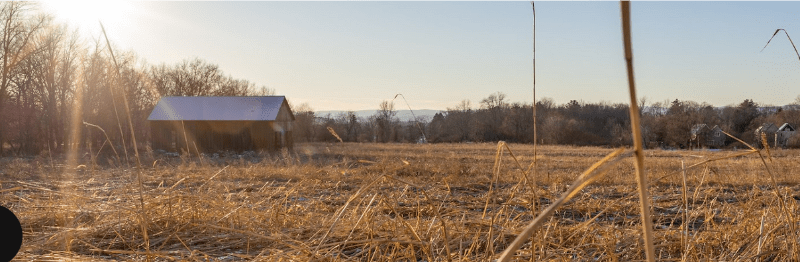
Of course, NACF doesn’t currently have the financial wherewith-all to purchase the buildings and equipment currently owned by Simple Gifts. However, there is our wonderfully remodeled and renovated farmhouse, which could serve as a very solid revenue generator. Our original intent for the farmhouse was to serve as an affordable accommodation for farm workers. Renting the farmhouse at market rate would prevent this original purpose for a while but could serve our larger mission in the long run. The NACF Board of Trustees has not made any decisions regarding this idea but we think that it is worth exploring.
We acknowledge that this news may be surprising to many of our most loyal supporters and Simple Gifts CSA customers. We have been quiet for the past two years, while Simple Gifts was in negotiation with potential new farm managers. But at this point, we felt we needed to share the situation with you, even as we have many still unanswered questions. You should know that we are committed to the long-term vision of maintaining a working, organic farming operation in North Amherst.
We appreciate that this email probably prompts more questions than it answers. So please contact us below with any specific queries or suggestions that you have.
PLEASE CONTACT Bruce Coldham at bcoldham155@comcast.net
or call 413-348-6706
 northamherstcommunityfarm.com