
Home » Articles posted by northamherstfarm
Author Archives: northamherstfarm
You are invited to a public meeting!
Following a public meeting at the North Amherst Library last fall, the North Amherst Community Farm Board continued to be in conversation with potential future farming operations and have had discussions about possible projects that would serve the North Amherst community. Among the most exciting projects are a community garden, a public orchard or food forest, and start-up (incubator) farming enterprises.
Before making decisions on any of these possibilities however, we have engaged the UMass Permaculture Design and Practice class from the Stockbridge School of Agriculture to help us think creatively about the future. NACF Board members have met with the students several times both in class and on the farm to discuss possibilities.
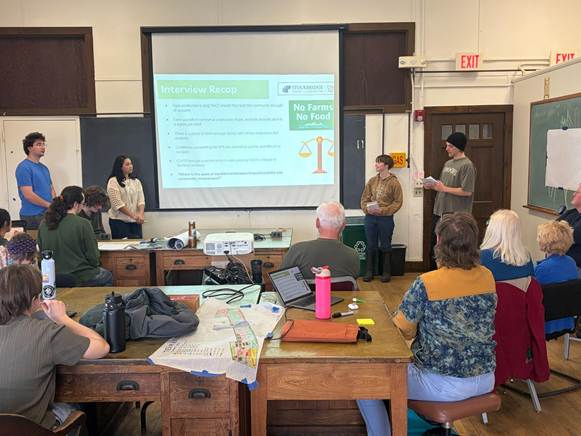
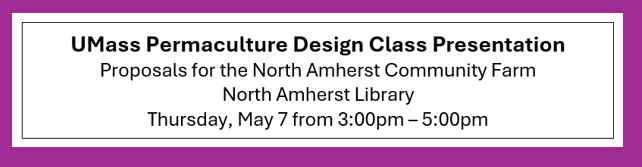
The UMass Permaculture Design Class will present the results of their analysis and proposed design for the farm to the NACF Board at a public event in May and you are invited!
Please join us for:
According to UMass faculty member, Lisa Depiano, “It is very meaningful for students to get a chance to work directly with their own clients on a real-life project alongside their peers. Our past clients have also found it helpful to have a focused time with students to help them think through their site goals, conduct a site analysis, and help them develop a master plan and other resources for their farm.”
We are as excited to hear their thinking as we are to hear your reaction to their presentation. This project continues to be a community effort, and as members of our local community, we still need your good ideas and suggestions. We hope you will join us for their final presentation on May 7.
——————————————–
What’s Been Happening at the Farm?
As you know, 2025 was a transition year for the North Amherst Community Farm, with several temporary projects. These were reported on our web page (Farming Activity at NACF in 2025). This past winter, we were fortunate enough to rent our greenhouses to the Sunderland-based farming operation, Kitchen Garden, to grow leafy green vegetables. While the snow was high outside the greenhouses, the greens thrived.
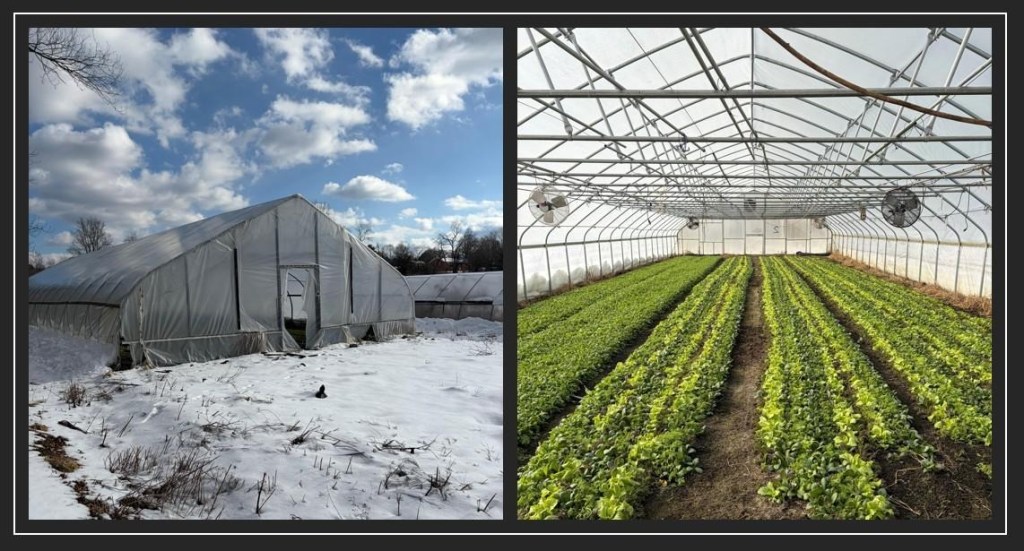
As April arrives, the snow is melting and we are getting excited to renew activities at the farm. Last fall we made significant progress cleaning up the barns and fields following 17 years of serving as an active organic vegetable farm. Several workdays, burn piles, and trips to the landfill have largely made the farm ready for whatever comes next. While we still have some work to do, we are making good progress.
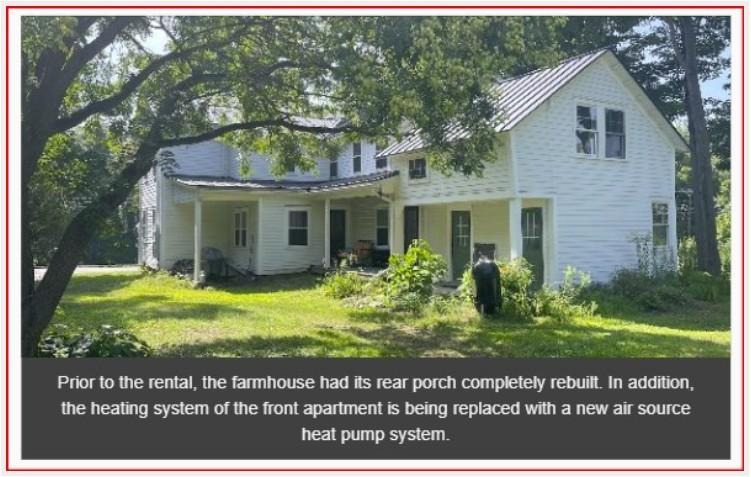
The good news is that the farmhouse on North Pleasant St. is rented for the coming year, providing us with an income stream to continue to make farm improvements. While transfer of responsibility for the farm from Simple Gifts to NACF has been an legal and financial challenge, we are indebted to the cooperation of our previous tenant farmers and the goodwill of our many supporters. The income from the farmhouse rental is being invested in maintenance of the property, which is key to the future of the farm. We are optimistic and look forward to a bright future for our favorite community farm.
Farming activity at NACF through 2025 season
| To maintain some farming activity through 2025 we sub-leased the eastern end of the farm to Wally Czajkowski to grow squash. Thanks to the high level of soil fertility (a legacy of Simple Gifts tenure) Wally harvested a bumper crop — over 300,000 pounds of squash from the 13 acres he planted. But there is more. Wally harvested the squash in mid-September leaving the immature squash in the field. But he did not immediately follow the harvest with a cover crop planting — he left the fields alone for another four weeks and in that time many of the immature squash ripened. NACF invited Rachel’s Table (a gleaning organization in the Valley) to arrange for a small army of people to roam the fields and gather the now “second crop”. Rachel’s Table gathered another 6,000 pounds for local food kitchens and the like. And then there were the local residents who, as part of their recreational wandering gathered hundreds of pounds in addition. It makes for a nice story!  Volunteer gleaners from Rachel’s Table gather late ripening squash  Neighbors to the farm and people passing by were able to gather a few squash for themselves as well  Wally’s teams of workers doing the primary harvest — all 300,000+ lbs of it |
Our farmhouse is now rented; and the”green” barn has a new roof

After two-and-a-half years of uncertainty some light is appearing at the end of our tunnel. NACF has moved successfully to secure the farmhouse initially by lease from Simple Gifts Farm and later (this year or next) we expect, as owner after successful debt settlement negotiations. We have entered a property management contract with Pipeline Properties to manage the rental of the farmhouse for the coming academic year. In the absence of the need to house resident farm families or farm workers, we will be renting to student tenants, and we will be dedicating some of the rental revenue to paying down loans taken out to pay debt settlement amounts. The debts are those of Simple Gifts but, in return for NACF agreeing to pay these settlement amounts, SGF will be returning ownership of the farm buildings (including the farmhouse) to NACF. So, from the end of August onward, expect to see new life in the NACF farmhouse.
Our newly hatched plan to use the farmhouse as a revenue generator goes against the original intention to commit the residence to housing farm families and farm workers — a promise that was the basis for our successful fund raising to fund the extensive renovation work six years ago. However, the greater need is to secure the future of the farm. The immediate need is to fend off a hostile foreclosure and to regain control of the farm buildings presently own by our lessee. Then there is a much longer term need — a need to create a revenue stream that we can rely on to fund continuing maintenance of the farm buildings once we regain ownership. The demise of Simple Gifts demonstrated that a farm lease agreement that obligated our farm lessee to maintaining the farm buildings was unworkable — unworkable and unfair because it obligated the lessee to paying the fair market price for the various trades needed to perform that maintenance work but restricted them from selling the buildings for anything more than their “adjusted market value” (essentially a sort of agricultural value which is much less). Therefore, just as with the original renovation work, maintenance would require an annual fundraising event to raise the money to bridge the gap between maintenance cost and resale value — clearly an unmanageably cumbersome solution.

So, our long-term plans for the farmhouse are shifting. It now seems critically important to use at least part of the farmhouse to generate operating income, Fortunately, the way we set up the renovated building — a front apartment designed to be suitable for three independent residents, a middle apartment designed to house a family, and a rear studio providing a self-contained studio apartment — gives us flexibility. The front apartment makes an ideal student rental. In Amherst (and being close to the University) this is a valuable rental commodity that will always be in demand. We imagine that even after we have paid down the loans we may take out to resolve the SGF debt, we will still be holding some portion of the farmhouse in the student rental market. That, we expect, will provide long-term financial security that will cover continued maintenance and other enduring needs.

In addition to the farmhouse, NACF has repaired the roof on part of the “green” barn. The long, single story structure had a white membrane installed by Simple Gifts 20 years ago over the failing ‘Onduline’ (corrugate fiber reinforced asphalt) original roofing. Last year the eastern section was blown off and the rain started pouring in. The wooden truss roof structure was under threat.
With SGF cooperation and with the assistance of many hours of volunteer labor, we repaired the underlying portions of rotted roof structure and prepared to pull a new prefabricated tarpaulin membrane over the damaged section. The question was just how to get the new 65ft. x 50ft. fabric weighing 500 lbs. up and over the barn. Well, the answer was (as in our past) getting 16 willing farm community volunteers to show up on Saturday August 8th for what we hoped would be a successful “pull-over”. In spite of all the things that could have gone wrong to frustrate a carefully planned operation — magically, it worked!!


Sowing seeds of support: Grow Food Northampton meets $1M goal to help local farms, fight hunger
| Original Post – Daily Hampshire Gazette | Published: 08-05-2025 3:41 PM Modified: 08-05-2025 5:41 PM |
By GRACE CHAI
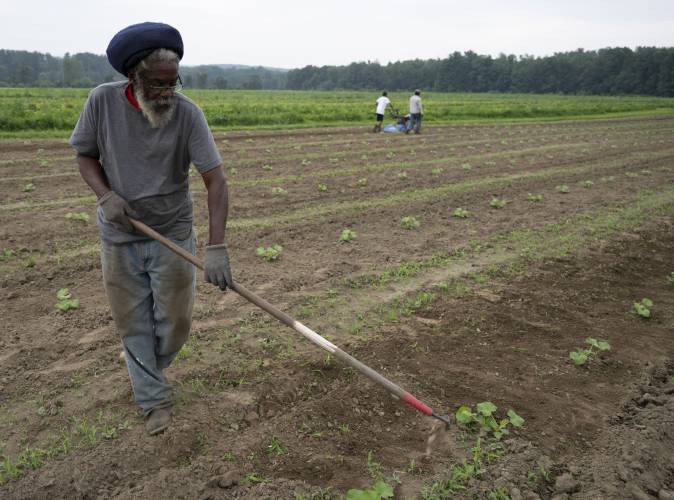
NORTHAMPTON — Leaning out of the window of his blue truck on a hot summer day last week, Courtney Whitely of Ras Farm recounted his journey to farming.
The Jamaica native had been a farmer for a long time working for other farms in the area before he obtained land to grow his own produce from Grow Food Northampton. To him, growing food requires a connection to the land, and understanding how to grow food that nourishes the body is important.
“You have to be one with the land,” Whitely said.
He learns a lot from the land, including when growing certain food doesn’t work out one season. Last year, he tried to plant kallaloo, a leafy green used in many Jamaican dishes, using plastic materials to support its growth, but it didn’t grow well. After planting it again differently this year, it thrived.
Now Whitely grows butternut squash, jalapenos and other vegetables to sell at Grow Food’s Tuesday Farmers Market. He found out about the Northampton nonprofit while browsing a website called New England Farmland Finder, where he discovered that the organization leases land to small farms.
Whitely is one of 10 farmers who have been able to lease land at affordable prices from Grow Food, the largest community farm in Massachusetts whose mission is to support local farms, provide land- and food-based education for children and adults, advocate for food security and practice sustainability.
The nonprofit’s role in the community began in 2010, when founders Lilly Lombard and Adele Franks — with the support of over 800 petition signatures from locals — lobbied for 121 acres in Florence to be preserved as farmland.
In the 15 years since its founding, Grow Food has established a community farm where it leases land to small farms, oversees a 320-plot community garden where people can grow their own food for an annual fee of $40 (or pay on a sliding scale), and operates a Giving Garden that grows thousands of pounds of food annually for donation to local food pantries and community meal sites. Grow Food also promotes education on local food and farming, runs a Tuesday Farmers Market and delivers free food to nine low-income housing sites each week.
This work has been bolstered along the way by a combination of funding sources, including the Northampton community and federal and state grants.
But as federal grants began to get wiped out under the Trump administration, Grow Food’s leaders saw the “writing on the wall,” as co-Executive Director Alisa Klein puts it, and last fall launched a campaign to raise more than $1 million for its Community Roots Fund. The campaign collected some $900,000 in private donations over the course of several months before opening to the public in June. Within six weeks, the organization raised the remaining $100,000.
Klein said that community members contributed with “remarkable generosity,” crediting the huge community response to people recognizing the role that Grow Food plays in feeding people in the city.
Klein says that while the organization had an “infusion of funds” for capital projects, its $1 million campaign is critical operational funding that will allow it to continue their programs and initiatives. The money will be used to support local farms and gardeners in the Community Garden and to implement climate resilience measures.
Some of these programs support its mission of education, as the organization has established a close relationship with Northampton Public Schools where students come to the community garden on an annual field trip.
“If we can engage kids in the local food system at a young age, if we can impart to them a sense of agency that they can create a healthy, vibrant, resilient local food system … they will go on to be kind of citizen activists to create that healthy local food system,” said Klein. “We feel like it’s really important to give them the tools to learn how to grow food, to have a relationship with the land.”
Grow Food also has classes on the community farm for adults to learn about farming and gardening. Klein says that the organization hones in on the cultural origins of different kinds of food and they talk about the history of the land.
Some of these programs will take place in a new pole barn, funded by a federal grant from U.S. Rep. Jim McGovern and a city grant from the Community Preservation Act, that Grow Food will use to host events, educational classes and more.
Recently, Grow Food held an event at its Living History garden, where food from different cultures grows alongside each other. Walking through the Living History garden feels like flipping through a richly diverse family album: covered in green leaves on a trellis are bumpy green bitter gourds; illuminated in bright sunlight are red okra, flax and molokhia, a leafy green used in many traditional Middle Eastern dishes. The garden represents the larger story of people hailing from all over the world who came to Northampton.
Impact of federal cuts
The organization relies on local generosity and private funding more than before to support these kinds of programs. According to Klein, Grow Food lost nearly one third of its budget due to federal funding cuts for grants such as the Local Food Purchase Assistance Cooperative Agreement Program (LFPA), which provided funding for groups like GFN that buy food from socially disadvantaged farmers and producers to provide to underserved communities.
Previously, the LFPA grant it received provided $400,000 over the course of three years. The nonprofit expected to renew the U.S. Department of Agriculture grant for another three years, but it was terminated in March.
Grow Food has also lost funding from a Farm to School grant that would have provided $50,000 for GFN’s education programs.
“We saw the writing on the wall, that we knew that hunger and food insecurity [were] rising in this valley,” said Klein. “And so we knew that we were at a moment where we had to figure out how to strengthen the organization’s ability to continue our work and to continue to feed people in the community.”
According to the Greater Boston Food Bank’s fifth statewide Food Access Report, food insecurity among Massachusetts households has increased to 37% in 2024 based on survey data. In the same report, Hampshire and Franklin counties were shown to be 50% food insecure and Hampden County as 54% food insecure, with food insecurity defined as “the experience of being unable to afford enough food to eat or worrying about where one’s next meal will come from.”
Role of farmers market
One way Grow Food combats food insecurity is through its Tuesday Farmers Market, which takes place behind Thornes Marketplace from April until November.
A popular community fixture, the market bustles with activity on a typical afternoon, with about 30 vendors selling produce and other goods to customers. Grow Food does Supplemental Nutrition Assistance Program (SNAP) matching at the market, doubling up to $10 of customers’ SNAP money. For every $10 spent in SNAP, for example, GFN gives someone $20 in tokens to buy anything SNAP eligible, like meat, cheese, fruits and vegetables. Massachusetts’ Healthy Incentives Program (HIP) is another program that helps SNAP recipients access free, local produce up to $40 per month and is also available at the farmers market.
Farmers market Manager Helen Kahn organizes the music, vendors and SNAP transactions. Standing under a tent that provided some respite from the blazing heat last week, Kahn helped marketgoers at the Grow Food table to the sound of a fan whirring.
“I think people don’t really realize how many food insecure families and individuals there are in this region,” said Kahn, who says that in the last four years, 30% of all purchases made at the market were made with SNAP. “I think [people] think Northampton and … erudite, privileged, wealthy. It’s not necessarily the case. It’s very important not only to have people able to use their SNAP and their healthy incentives program to buy fresh fruits and vegetables, but in addition to that, the SNAP match that we’re providing is helping people purchase even more.”
According to Kahn, the organization processes 120 to 160 transactions at its table every market. Between the farmers markets in the summer and the winter, Grow Food gives out $55,000 each year to food-insecure households. Kahn says that the program benefits both SNAP recipients and farmers.
Additionally, Grow Food takes the market on the road every week to reach more people through its mobile farmers market. Two teams of volunteers, each led by a food access assistant, split up to deliver free food like tomatoes, eggplants and greens from local farms to nine low-income housing sites. The market serves about 250 households each week, with people picking up food for their families, according to Erin Ferrentino, food access manager.
Several residents, including Robin Hicks, 63, visit the mobile market every week. Hicks, who lives at Cahill Apartments, is eight years sober from alcohol and heroin and now lives with her 10-year-old cat. The mobile market is part of her Thursday morning routine.
A few feet away from the table of produce, she pressed play on her phone, the tune of a song she calls “One Day at a Time” drifting into the air. She danced a little, humming the lyrics with a smile on her face. One day at a time — or ODAAT — is her motto.
“I love these people,” she said, looking toward the table of volunteers. “I am so very grateful to [Grow Food Northampton] for coming every week.”
Spring clean up started at our local farm
Thanks to the crew of volunteers who helped spruce up the North Pleasant entrance to the North Amherst Community Farm! The perennial beds are shaping up but we could still use some help weeding between the plants. If you have a half hour, please stop by and pull some grass out of these lovely flower beds.

The crew also tackled the front end and porch of the farm house (which is currently empty). The NACF Board of Directors is working on a plan to generate some income for the farm from rentals, so we need to make sure the property is presentable.
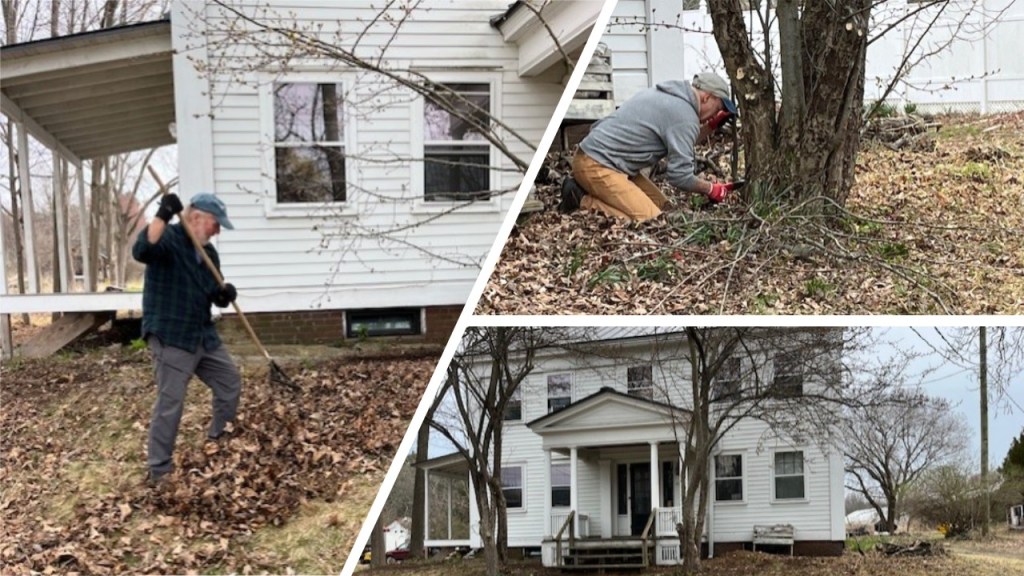
Special thanks to our volunteer clean up crew:

What’s happening with NACF for the 2025 growing season?
 Wally Czajkowski (at left) with Dave Tepfer on the farm as Dave and he review the terms of the sub-lease. Off from Wally’s shoulder (in the distance) you can see some of the composted goat manure that he will be spreading to accelerate the growth of his squash crop.Wally’s presence means that there will be productive activity on the land. That will be good for our morale, and it will also prevent the maturing and seeding of weed plants that would otherwise thrive in the fields. Wally has agreed to plant a winter cover crop before he leaves.

What’s happening with North Amherst Community Farm – an update; January 2025
In 2006, the North Amherst Community Farm (NACF) was created to preserve one of the last working farms in North Amherst, MA. Thanks to generous contributions from many of you along with town and state support, we now own this 30-acre farm which is protected from commercial development in perpetuity. Our 18-year partnership with Jeremy Barker-Plotkin and David Tepfer, the managers of Simple Gifts Farm, has resulted in the construction of a year-round farmstand, the renovation of the farmhouse, active greenhouse and other buildings, an irrigation system and much more. By combining our collective efforts, NACF and Simple Gifts Farm have formed a successful public-private partnership that promotes sustainable and organic farming methods, provides healthy farm products to the region, educates the community on food and farming issues, and helps preserve the agricultural heritage and character of the North Amherst Village Center.

In many ways, our efforts have been successful. Nevertheless, the continued financial viability of any small organic family farm struggling to survive in New England is threatened by the corporately controlled industrial food system. Two years ago, our farm partners, Jeremy and David, decided to sell their financial interest in the farm. For the past two years they have negotiated with several potential buyers, but at this point have been unsuccessful. The farm and farmstand were operated at a limited scale last year but since both farmers have accepted other jobs, the farm is not currently in operation. NACF is in a position where decisions must be made about what’s next.
The current situation is that we, NACF, own the land and Simple Gifts Farm owns the value of the buildings and equipment. Simple Gifts has not been able to identify a suitable buyer for their interests. One of the things we are thinking about is that NACF could acquire the farm buildings from SGF and then look for a successor farming enterprise who could lease the farm without first having to come up with what amounts to a hefty down payment. This idea is in a formative stage but has the advantage of giving NACF more control over how the land is used. It also has the promise of greatly expanding the number of prospective successor farmers.
Of course, NACF doesn’t currently have the financial wherewith-all to purchase the buildings and equipment currently owned by Simple Gifts. However, there is our wonderfully remodeled and renovated farmhouse, which could serve as a very solid revenue generator. Our original intent for the farmhouse was to serve as an affordable accommodation for farm workers. Renting the farmhouse at market rate would prevent this original purpose for a while but could serve our larger mission in the long run. The NACF Board of Trustees has not made any decisions regarding this idea but we think that it is worth exploring.
We acknowledge that this news may be surprising to many of our most loyal supporters and Simple Gifts CSA customers. We have been quiet for the past two years, while Simple Gifts was in negotiation with potential new farm managers. But at this point, we felt we needed to share the situation with you, even as we have many still unanswered questions. You should know that we are committed to the long-term vision of maintaining a working, organic farming operation in North Amherst.
We appreciate that this email probably prompts more questions than it answers. So please contact us below with any specific queries or suggestions that you have.
PLEASE CONTACT Bruce Coldham at bcoldham155@comcast.net
or call 413-348-6706
Our historic barn deconstruction under way

The J-Team began their work to deconstruct the old barn.
Thanks to all of those who helped clean out the barn last April. That set the stage for this work to happen. We will be looking for additional help from active farm community members again when the take-down is complete and we have a pile of irredeemable wood waste that must be shifted up to the middle of the farm for burning.

The barn dates from the mid 19th century. It supported the original dairy farm but hadn’t been used as such for almost 50 years. Neither NACF nor Simple Gifts could think of a good use for such a large building, in such bad condition, so far away from the active farmland. The building was beyond repair really. So, reluctantly, we decided to take it down, and the Town Historic Commission agreed, with the understanding that we committed to extensive salvage of the material.
 northamherstcommunityfarm.com