
News & Views
What’s happening with NACF for the 2025 growing season?
 Wally Czajkowski (at left) with Dave Tepfer on the farm as Dave and he review the terms of the sub-lease. Off from Wally’s shoulder (in the distance) you can see some of the composted goat manure that he will be spreading to accelerate the growth of his squash crop.Wally’s presence means that there will be productive activity on the land. That will be good for our morale, and it will also prevent the maturing and seeding of weed plants that would otherwise thrive in the fields. Wally has agreed to plant a winter cover crop before he leaves.

What’s happening with North Amherst Community Farm – an update; January 2025
In 2006, the North Amherst Community Farm (NACF) was created to preserve one of the last working farms in North Amherst, MA. Thanks to generous contributions from many of you along with town and state support, we now own this 30-acre farm which is protected from commercial development in perpetuity. Our 18-year partnership with Jeremy Barker-Plotkin and David Tepfer, the managers of Simple Gifts Farm, has resulted in the construction of a year-round farmstand, the renovation of the farmhouse, active greenhouse and other buildings, an irrigation system and much more. By combining our collective efforts, NACF and Simple Gifts Farm have formed a successful public-private partnership that promotes sustainable and organic farming methods, provides healthy farm products to the region, educates the community on food and farming issues, and helps preserve the agricultural heritage and character of the North Amherst Village Center.

In many ways, our efforts have been successful. Nevertheless, the continued financial viability of any small organic family farm struggling to survive in New England is threatened by the corporately controlled industrial food system. Two years ago, our farm partners, Jeremy and David, decided to sell their financial interest in the farm. For the past two years they have negotiated with several potential buyers, but at this point have been unsuccessful. The farm and farmstand were operated at a limited scale last year but since both farmers have accepted other jobs, the farm is not currently in operation. NACF is in a position where decisions must be made about what’s next.
The current situation is that we, NACF, own the land and Simple Gifts Farm owns the value of the buildings and equipment. Simple Gifts has not been able to identify a suitable buyer for their interests. One of the things we are thinking about is that NACF could acquire the farm buildings from SGF and then look for a successor farming enterprise who could lease the farm without first having to come up with what amounts to a hefty down payment. This idea is in a formative stage but has the advantage of giving NACF more control over how the land is used. It also has the promise of greatly expanding the number of prospective successor farmers.
Of course, NACF doesn’t currently have the financial wherewith-all to purchase the buildings and equipment currently owned by Simple Gifts. However, there is our wonderfully remodeled and renovated farmhouse, which could serve as a very solid revenue generator. Our original intent for the farmhouse was to serve as an affordable accommodation for farm workers. Renting the farmhouse at market rate would prevent this original purpose for a while but could serve our larger mission in the long run. The NACF Board of Trustees has not made any decisions regarding this idea but we think that it is worth exploring.
We acknowledge that this news may be surprising to many of our most loyal supporters and Simple Gifts CSA customers. We have been quiet for the past two years, while Simple Gifts was in negotiation with potential new farm managers. But at this point, we felt we needed to share the situation with you, even as we have many still unanswered questions. You should know that we are committed to the long-term vision of maintaining a working, organic farming operation in North Amherst.
We appreciate that this email probably prompts more questions than it answers. So please contact us below with any specific queries or suggestions that you have.
PLEASE CONTACT Bruce Coldham at bcoldham155@comcast.net
or call 413-348-6706
Our historic barn deconstruction under way

The J-Team began their work to deconstruct the old barn.
Thanks to all of those who helped clean out the barn last April. That set the stage for this work to happen. We will be looking for additional help from active farm community members again when the take-down is complete and we have a pile of irredeemable wood waste that must be shifted up to the middle of the farm for burning.

The barn dates from the mid 19th century. It supported the original dairy farm but hadn’t been used as such for almost 50 years. Neither NACF nor Simple Gifts could think of a good use for such a large building, in such bad condition, so far away from the active farmland. The building was beyond repair really. So, reluctantly, we decided to take it down, and the Town Historic Commission agreed, with the understanding that we committed to extensive salvage of the material.
The farm store — a wonderful community resource in 2020
| The farm store — a wonderful community resource in 2020, tough though it was, had some silver linings. Many of us spent more time talking to friends in faraway places; we put less carbon into the atmosphere; and we even found that some people do better with remote working than they do in classrooms or offices. Well, there have been some silver linings for Simple Gifts Farm and our farm community as well. |
 People have seen the store Simple Gifts Store as a convenient and very safe place to shop. It was heartening to see the local food system demonstrate resilience in the face of crisis in global supply chains. Sales activity really spiked in the first month or two after the pandemic’s onset and then tapered as the summer approached and people felt more comfortable re-entering supermarkets. In the fall, SGF did a burst of strategic marketing that bumped sales back up. Over the year, sales activity at the farm store almost doubled and that was reassuring to our farmers. To order from Simple Gifts Farm Store online go to; https://www.simplegiftsfarmcsa.com/store/ Local people have seen the store as a convenient and very safe place to shop — especially with the on-line ordering for site pick-up. Farmer Jeremy says it was inspiring to see the extent to which the local food system demonstrated resilience in the face of crisis in global supply chains. The local food movement has long touted the value of shorter supply chains, and the pandemic certainly demonstrated those benefits. The hope is that people’s habits have changed and that the increased support for local food continues to be strong. Simple Gifts Farm has also consolidated their farm crew — no longer using farm apprentice-type labor, they have built a more permanent and more skilled workforce. With this they have been developing more sophisticated methods including no-till and low-till planting. Transplanted seedlings are dropped straight into a mulch-covered ground prepared the previous fall. The great benefit in low soil tillage is that it retains soil fertility because micro-organisms are not disturbed, and soil organic material is not lost. Farmer Dave explained that “tilling soil is like running a woodstove with the draft gate wide open: it “burns” faster”. Tilling the soil means that soil-retained carbon is lost back to the atmosphere — not the place we want to see it going these days. Low-tillage operations on the other hand retain soil carbon and also involve less soil erosion. SGF is practicing a more and more sustainable agriculture — and BTW have you tasted their carrots? They are sweeter than ever! .  |
THANK YOU ALL FOR ALL THAT YOU HAVE DONE NACF continues our effort to improve the farm experience for our farm community, and we will continue to tell when and how you can help us. You can support us with a DONATION at nacfonline.org or by clicking on the “DONATE” button below DONATE FOR MORE INFORMATION please contact — Bruce Coldham at bcoldham155@comcast.net |
A year on — and what a year!
Our renovated farmhouse has entered its second year of active duty, and what a year. And what a life-line it has been for the farm. The arrival of the coronavirus and its associated stay-in-place orders has destroyed some businesses and severely hampered most others. SGF has had to adjust as well, but the expanded capacity of the farmhouse has meant that the essential farm labor force could live in a functional “bubble”, and this has been a lifesaver figuratively (and maybe also literally).
The seven occupants of the farmhouse live in two separate apartments with on-site access to all that needs to be done on the farm. They can and do perform their tasks safely and without the uncertainty associated with our current predicament.
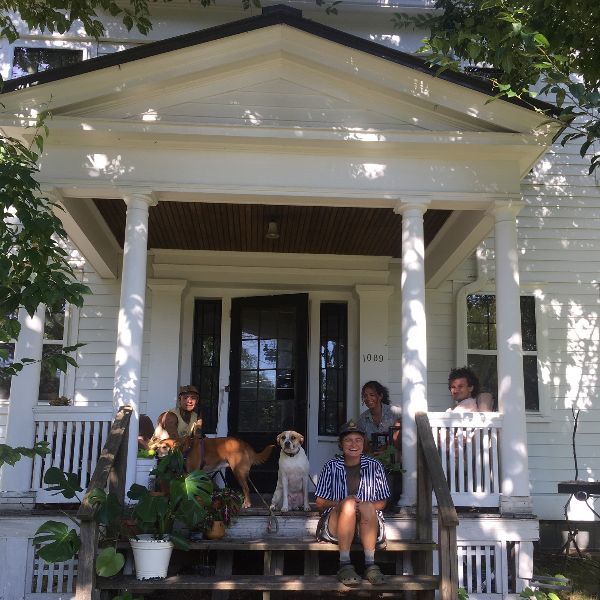
“For us it is a beautiful house imbued with the love and support of a community that really cares”.
Farm Manager Jada Haas says — “We want to be at peak performance so that we can keep our regenerative agricultural systems going, making them better and better. Having this place to live so close and so comfortable, even without the pandemic, it’s so important. But now we can’t imagine how we would be functioning without it”.
So we all have even more to be proud of. Last summer when we raised the “last dollar” to secure the farm and its farmhouse for posterity we knew we had done well. Now it seems that we have done even better and more than we thought.

The farmhouse residents have their own intensive veggie patch
THANK YOU ALL FOR ALL THAT YOU HAVE DONE
NACF continues our effort to improve the farm experience for our farm community, and we will continue to tell when and how you can help us.
You can support us with a DONATION at nacfonline.org or by clicking on the “DONATE” button below

FOR MORE INFORMATION — Bruce Coldham at bcoldham155@comcast.net
We have done it!
Five years ago the NACF board had two enormous and persistent challenges even after 10 years of accomplishment. We had a $400,000 mortgage obligation to discharge, and we had an obligation to our lessee farmers to stabilize (and ideally enhance) the crumbling buildings — the farmhouse and barns — that we inherited.
Now, five years later, with the wonderful support of our community, we have fully retired the debt on the land and we have completed a major renovation of the farm house. Furthermore, at our June fundraising event, we raised the “last dollar” to pay for all this.
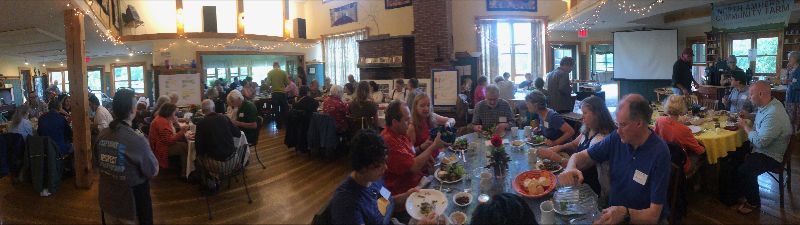
Over 80 supporters attending our June 16th Sunday Brunch fundraiser. We raised over $11,000 “in the room” and a further $9,000 from others unable to attend, thereby achieving our goal. The farmhouse renovation is fully paid for.

So we now have a strong and stable basis to support our lessee farmers who themselves have made (and are making) substantial investments in the farming infrastructure: the (more…)
NACF supports the “Common Good”
 The North Amherst Community Farm Board of Directors is pleased to be able to support the Common Good Project, which is a local effort to promote a Common Good Economy—a democratic, community-centered financial system the puts people and planet first, so that everyone has enough to eat, a home, healthcare, satisfying work, and a livable world.
The Common Good payment card which may be used at Simple Gifts farmstand generates funds for our community’s projects every time you use it. Members decide together what to fund. It’s easy to use, easy to accept as payment. And there are no fees for either the buyer or the businesses.
Here’s how it works:
- Open an account online at CommonGood.earth
- Put some money in it.
- Use your card for purchases at Simple Gifts and a growing number of participating businesses.
Simple….
Like a bank, our community can invest money held in the accounts. Unlike a bank (more…)
Common Good Fund supports local projects – please join!

NOTE: Simple Gifts Farmstand in North Amherst accepts the Common Good card. By joining the Common Good Fund project, you will help us invest in local projects in Amherst like the one described below! Please join here:
https://new.commongood.earth/signup
CUMMINGTON — Nutwood Farm will soon have a solar powered pump to run its well, thanks to a $1,000 grant from Greenfield Common Good, a nonprofit non-bank financial institution that supports social change and community empowerment.
“We applied last summer and we were very excited when we heard we got it,” farm owner Seva Tower said.
In December, Common Good selected 14 projects to receive $19,000 in grants, loans, and equity investments. The projects that received funding focused on topics such as food systems, sustainability and renewable energy, small business development, social justice and the arts.
“We have been thinking a lot about water, and while we are blessed with water in the Northeast, it is still a precious resource,” Tower said. “Climate chaos also makes things a lot more challenging, and a solar water pump on the well will ensure that we can still pump water if the electricity goes out.”
Tower owns the farm with partner Kalyan Uprichard. Utilizing a swale and berm system, the couple has planted 350 nut trees to produce hazelnuts, chestnuts, walnuts, hickory nuts and butternuts.

Seva Tower and Kalyan Uprichard with their planted nut trees on their farm, Nutwood Farm in Cummington. STAFF FILE PHOTO/CAROL LOLLIS
By growing these trees sustainably and supplying nuts locally, Tower and Uprichard hope to help shift the local food system toward “regenerative agriculture and develop long-term food sovereignty and bold economic sufficiency.”
Tower says that they have received a great deal of support from the community and people in the region. She noted that it has been difficult to secure loans from traditional banks and praised Common Good for helping their farm.
“It’s a small amount but really useful, and it is so refreshing because we have struggled to get financing from traditional institutions,” she said.
Common Good is a system where members use credits instead of dollars at participating retailers. Those dollars then sit in a pool that builds as more people use the Common Good card. The pool eventually grows to the point where the funds can be dispersed for projects that benefit the local community.
“The Common Good is a pretty incredible organization and it is amazing to have them in this area,” Tower said.
Restoration of the Farmhouse
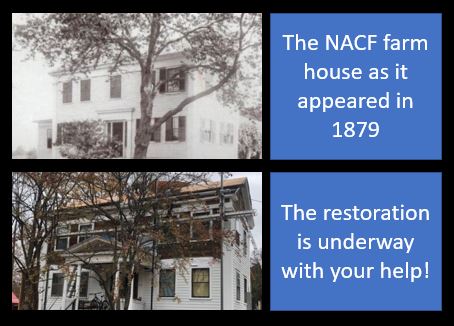
The North Amherst Community Farm has restored the original farmhouse that has been part of the property since the 1830’s. The history of the farm house offers an interesting view of how farming in the Pioneer Valley has changed over the past 200 years. Initially a grain and livestock farm, after the Civil War the farm shifted to raising meat and vegetables for local sales and shipping. In the 20th century ownership of the farm passed from the Ingram-Dickinson’s to the Dziekanowski’s, with the latter developing a dairy operation.
In 2005, the Dziekanowski’s sold the property to the North Amherst Community Farm, a non-profit entity formed to protect the land from development. NACF now leases the property to Simple Gifts Farm, managed by Jeremy Barker-Plotkin and David Tepfer. Simple Gifts is a leader in the local organic farming sector, growing food for the local community and maintaining the land and buildings in active farm use.
Almost one-third of New England farms are managed by farmers over 65 years of age. To preserve the distinctive character of our region, strengthen local food security and continue our farming traditions, we need to cultivate the next generation of farmers! The state of Massachusetts, and the town of Amherst, have done a good job of preserving farmland, but housing costs can be another major barrier for young people seeking to get into farming. This project will help address that need.
The restoration of the NACF farmhouse was completed with the help of Community Preservation Act funding from the Town of Amherst. A critical step was to hire a historic buildings consultant, Gregory Farmer, to assist us in researching the previous 180 years in the life of this important farm structure.
We then developed detailed plans for the restoration and remodeling of the farmhouse. It is a major undertaking, with a total budget of around $400,000. This project has:
– provided a functional, affordable farmhouse able to accommodate multiple occupancy scenarios (two separate living units with a total of four bedrooms
– achieved full compliance with all building codes
– reduced future maintenance expenses to a manageable level
– restored the building to its rightful place as an attractive presence on North Pleasant Street.
For more on this story and pictures of the progress we are making, please continue to look at additional blog posts below!
Existing community support for this project includes:
• The Town of Amherst
• The Dziekanowski Family
• Interfaith Housing Corporation of Amherst
• Kestrel Land Trust
• Habitat for Humanity
• Smith Vocational High School
• + more than 700 individual members of the local community
Through both financial gifts, in-kind donations, and volunteer labor from these groups, we completed project in the spring of 2019.

